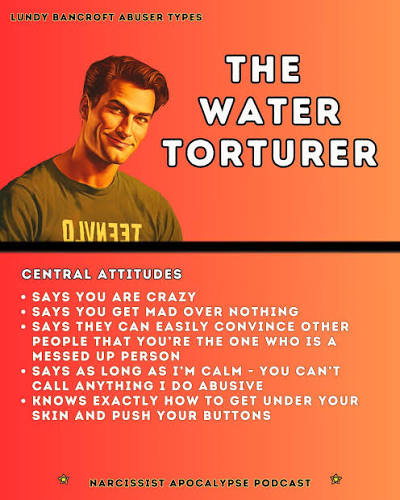

There’s a type of abuse described by Lundy Bancroft in Why Does He Do That? that really stood out to me: “The Water Torturer.”
The name might sound extreme, but the behavior Bancroft describes is often anything but obvious.
The Water Torturer doesn’t necessarily scream. He may rarely raise his voice. Instead, the abuse comes through a slow, steady stream of sarcasm, criticism, dismissal, needling, and cruelty.
It can look like:
• Saying you’re “crazy” or that you’re overreacting.
• Telling you that you’re getting upset over “nothing.”
• Deliberately pushing the exact buttons he knows will upset you.
• Saying something cruel and then acting completely calm when you react.
• Turning your reaction into proof that you are the problem.
• Convincing other people that you’re the unreasonable one because they only see his calm demeanor.
• Making you question yourself because, from the outside, there may not be one dramatic incident you can point to.
• Wearing you down through repetition until you finally break down, cry, yell, or become frustrated—then using that reaction against you.
And this is the part I think is so important:
Being the person who eventually raises their voice does not automatically make you the abusive person.
Sometimes people react strongly because they have been pushed, dismissed, provoked, criticized, or emotionally worn down for a very long time.
That doesn’t mean every argument or unhealthy relationship fits this description. But if you have lived through something like this, you may recognize the feeling immediately: “How did I end up looking like the problem when I was the one who was hurting?”
I can empathize with the people who have experienced this because I understand how confusing it can be when the person hurting you appears completely calm while you are falling apart.
That calmness can make you question yourself.
It can make you think, Maybe I really am too sensitive. Maybe I really am the problem. Maybe if I could just explain myself better, this would stop.
But there is another part of this that I think is important to understand: the hurt accumulates.
It’s one comment.
One jab.
One dismissal.
One sarcastic remark.
One deliberate button pushed.
One more time being told that you’re overreacting.
One more time being made to feel like your feelings are the problem.
Any one of those moments might seem small to someone looking from the outside. But they don’t happen in isolation. They accumulate over time.
It’s like being subjected to a constant drip. One drop doesn’t seem significant. But the drops keep coming. And eventually, the accumulated weight of all those little moments becomes something you can no longer carry.
You become exhausted.
You become hyperaware of the next comment.
You start questioning yourself.
You lose confidence in your own perception.
You may become more emotional, more reactive, or more desperate to finally be heard.
And then that reaction can be held up as evidence that you are the problem.
That is part of what makes this kind of abuse so incredibly confusing and painful.
The final reaction is visible. The accumulation that caused it often isn’t.
People may see you crying, yelling, or finally breaking down. They may not have seen the hundreds of little moments that happened before you got there.
And sometimes, neither do you—not at first.
You just know that you’re exhausted. That you’re hurting. That you don’t recognize yourself anymore. That something that once seemed like “little things” has somehow become unbearable.
If you have experienced this, I want you to know that I see why it can be so difficult to explain.
You don’t have to have one catastrophic story to justify why you are hurting.
Sometimes the damage comes from the accumulation of things that were individually dismissed as nothing.
One drop doesn’t seem like much. But you can only endure the dripping for so long.